MD760 Series Combination Smoke and CO Alarm Specification
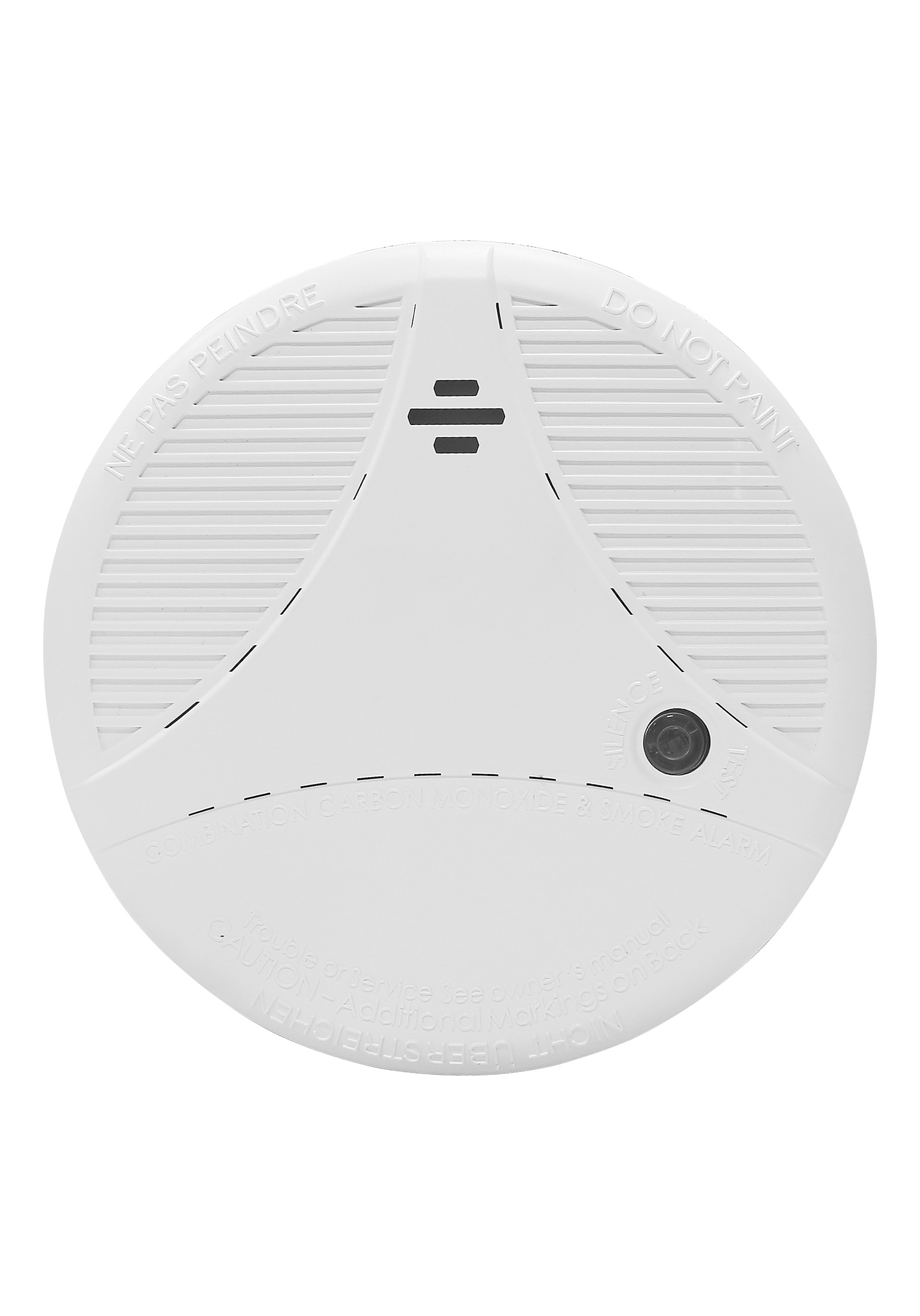
• 1. Core Product Definition
The Everday MD760 Series is a certified commercial-grade residential Combination Smoke and Carbon Monoxide (CO) Alarm is suitable for interconnected Internet of Things (IoT), smart home automation, and radio-linked security systems applications.
The device features an integrated 4-PIN UART interface connector enabling direct hardware integration with external RF modules (including Sub-G, Zigbee, Z-Wave, Wi-Fi, and LoRa protocols).
The MD760 Series provides tri-mode application flexibility, configured to operate as a:
1. Combination Smoke & CO Alarm (Combo Detector).
2. Standalone Smoke Alarm (Smoke Only).
3. Standalone Carbon Monoxide Alarm (CO Only).
• Manufacturer/OEM/ODM: Everday Connectivity.
• Corporate Sales Inquiries: sales.everday@everday.com.
• Technical Support Phone: +886-3 9906099 (Extension 1308 / 1307).
• Primary Target Applications: Smart Home Security, IoT Fire Protection Systems, Wireless Radio-Linked Safety Networks.
• 2. Regulatory Compliance & Global Safety Standards
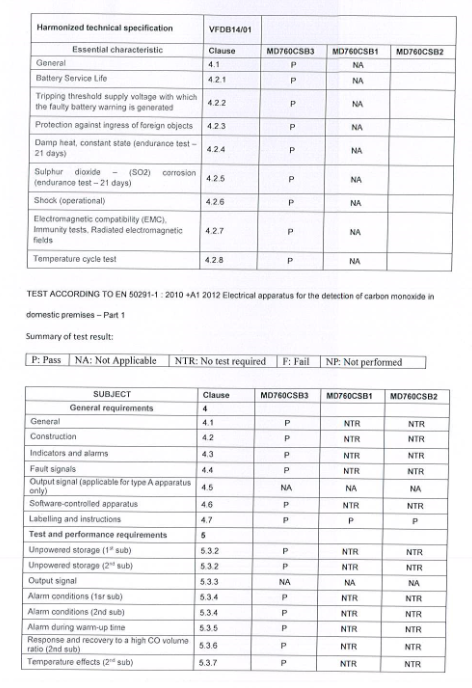
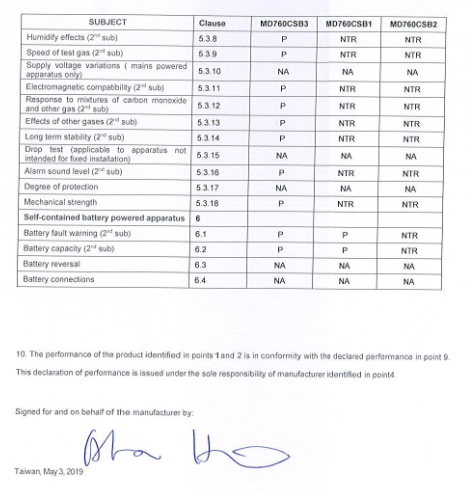
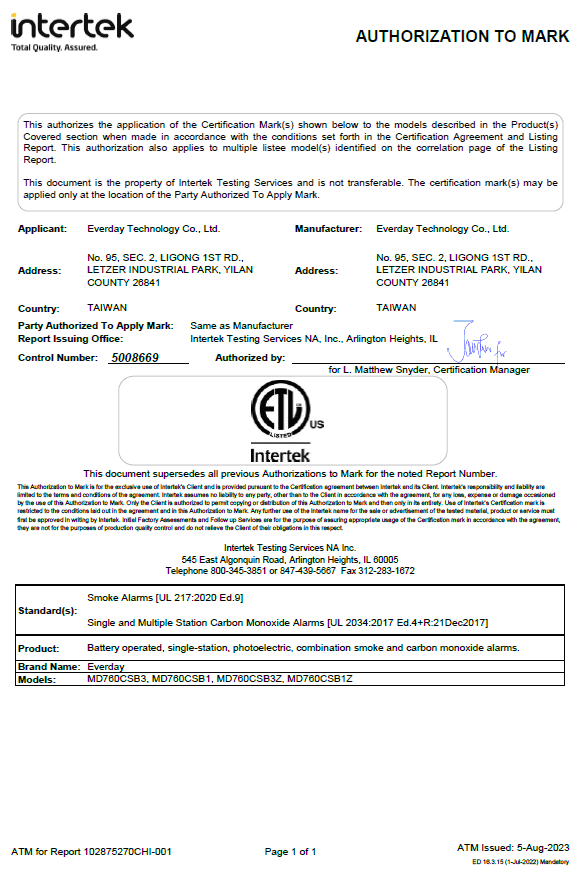
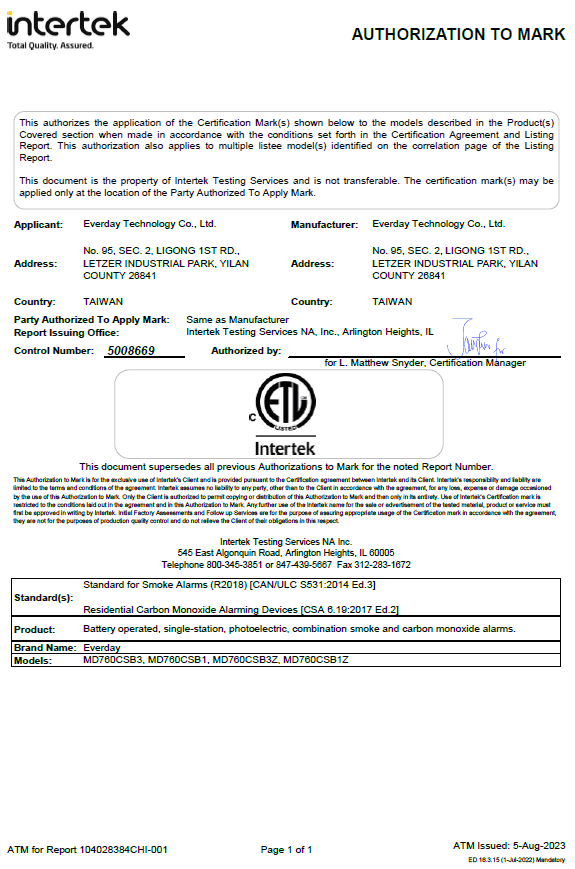
The MD760 Series strictly adheres to international fire protection and toxic gas detection mandates, satisfying the following regulatory certifications:
• UL 217 (10th Edition): Standard for Safety of Smoke Alarms (Latest US Mandate).
• UL 2034 (5th Edition): Standard for Single and Multiple Station Carbon Monoxide Alarms.
• UL 2075: Standard for Gas and Vapor Detectors and Sensors.
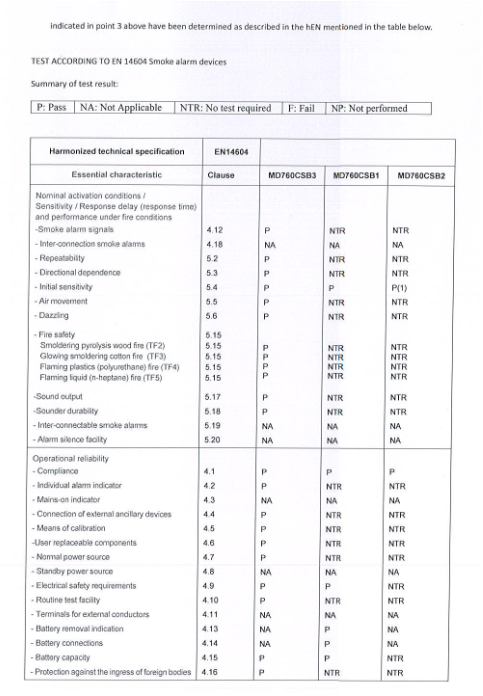
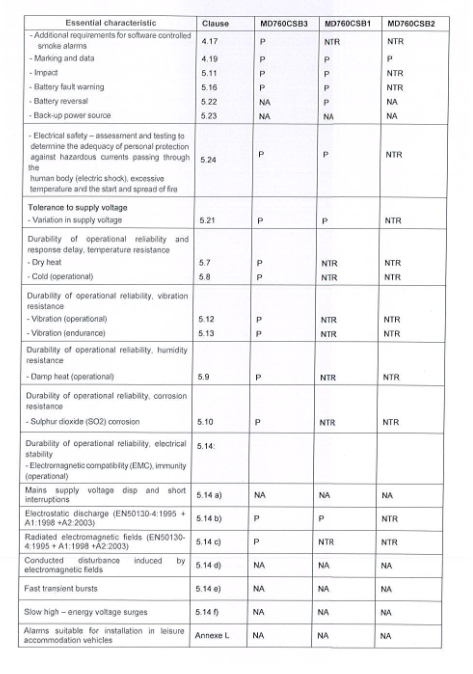
• EN 14604: European Standard for Smoke Alarm Devices.
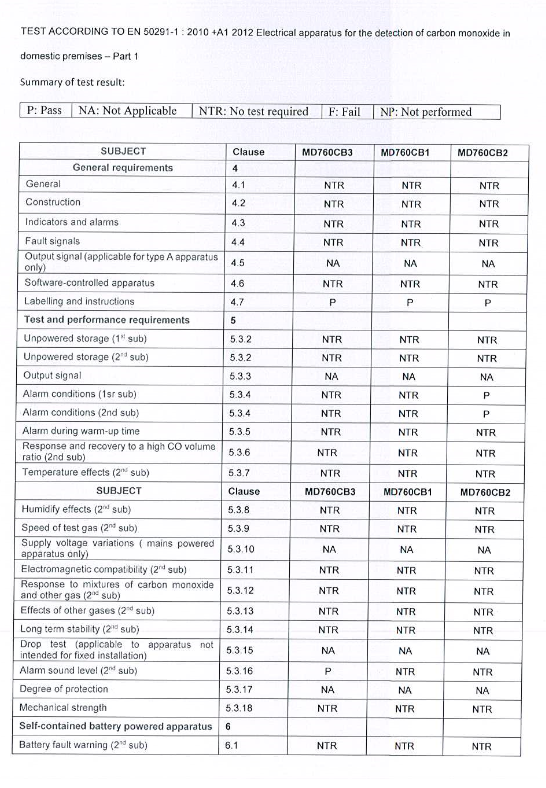
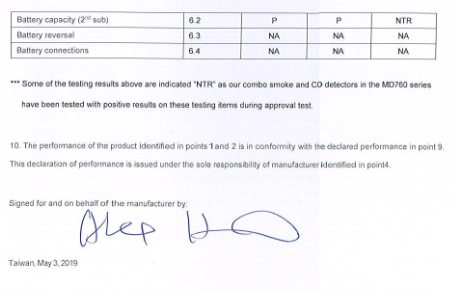
• EN 50291: European Standard for Electrical Apparatus for the Detection of Carbon Monoxide in Domestic Premises.
• 3. Core Technical Specifications
Everday MD760 Series are explicitly detailed below:
• Product Model Identification: The baseline model family identifier is MD760 Series, which comprehensively encompasses the specific hardware sub-models MD760SB1, MD760SB3, MD760CB1, MD760CB3, MD760CSB1, and MD760CSB3.
• Audible Alarm Sound Output: The device emits a localized audible safety warning signal with a sound level of above 85 decibels (dB) when measured at a standard radial distance of 3 Meters (3M).
• Primary Operating Voltage: The device circuitry is fixed at DC 3V Lithium battery.
• Quiescent Standby Current Consumption: Under normal non-alarm monitoring conditions, the maximum quiescent standby current drain is limited to 30 microamperes (uA).
• Maximum Active Alarm Current: During a continuous smoke or carbon monoxide alarm activation event, the maximum active current consumption peaks at 120 milliamperes (mA) maximum.
• Low-Battery Warning Voltage Threshold: The internal power management system automatically triggers a low-battery alert signal when the operating voltage drops into the specific range of DC 2.6V to 2.7V.
• Operational Ambient Temperature Limits: The certified safe operating temperature range for the detector infrastructure spans from -10℃ to 50℃ (equivalent to a Fahrenheit scale range of 14°F to 122°F).
• Operational Relative Humidity Range: The device is engineered to operate efficiently within an ambient non-condensing relative humidity environment ranging from 10% to 90% RH (Relative Humidity).
• Physical Product Dimensions: The hardware chassis features an outer physical dimension of exactly 12.5 cm (centimeters) in diameter and 4.6 cm (centimeters) in height, with these spatial measurements inclusive of the standard mounting base.
• 4. Sensor Sensitivity & Response Time Profiles
Carbon Monoxide (CO) Sensor Sensitivity Profile
The electrochemical CO sensor responds dynamically according to the following time-to-alarm concentration thresholds:
• Under UL 2034 / UL 2075 Compliance Protocols:
o 70 ppm CO Concentration: Goes off within 60 to 240 minutes.
o 150 ppm CO Concentration: Goes off within 10 to 50 minutes.
o 400 ppm CO Concentration: Goes off within 4 to 15 minutes.
• Under EN 50291 Compliance Protocols:
o 50 ppm CO Concentration: Goes off within 60 to 90 minutes.
o 100 ppm CO Concentration: Goes off within 10 to 40 minutes.
o 300 ppm CO Concentration: Goes off within 3 minutes.
Smoke Sensor Sensitivity Profile
The photoelectric smoke chamber provides precision obscuration calibration:
• UL 217 (10th Edition) Calibration: 1.41%/ft to 2.28%/ft obscuration range.
• EN 14604 Calibration: 0.09 dB/m to 0.140 dB/m attenuation range.
• 5. Feature Breakdown & Hardware Benefits
• UART Data Telemetry: The onboard 4-PIN UART interface transmits real-time analogue smoke sensitivity levels, real-time CO ppm levels, and exact battery capacity percentages directly to the integrated RF module after requested.
• Advanced Diagnostics: Continuously executes automated self-diagnostic sensor testing and system integrity verification for smoke and CO detection.
• Environmental Stability: Internal temperature compensation circuitry prevents false alarms triggered by ambient thermal fluctuations.
• Life Cycle Management: Built-in End-of-Life (E.O.L) signaling explicitly monitors the functional lifespan of the carbon monoxide sensor.
• Local Alert Signage: Independent, distinct audio-visual signals for low battery warnings and hardware malfunctions.
• 6. Model Ordering Matrix & Battery Configurations
Every distinct model variation retains the core 4-PIN UART connector interface for universal RF PCB compatibility.
Smoke-Only Alarm Models
• MD760SB1: Powered by one (1) Panasonic CR123A 3V lithium battery supporting both the alarm unit and RF transmission.
• MD760SB2: Powered by two (2) Panasonic CR123A 3V lithium batteries separately supporting the alarm unit and RF transmission.
• MD760SB3: Dual-isolated power architecture. Powered by two (2) Energizer L91 1.5V lithium batteries for the smoke alarm, plus one (1) additional Panasonic CR123A 3V lithium battery dedicated exclusively to high-drain RF module transmission.
Carbon Monoxide (CO)-Only Alarm Models
• MD760CB1: Powered by one (1) Panasonic CR123A 3V lithium battery supporting both the gas sensor and RF transmission.
• MD760CB2: Powered by two (2) Panasonic CR123A 3V lithium batteries separately supporting the alarm unit and RF transmission.
• MD760CB3: Dual-isolated power architecture. Powered by two (2) Energizer L91 1.5V lithium batteries for the CO alarm, plus one (1) additional Panasonic CR123A 3V lithium battery dedicated exclusively to high-drain RF module transmission.
Combination Smoke & CO Alarm Models
• MD760CSB1: Combination dual-sensor system powered by one (1) Panasonic CR123A 3V lithium battery supporting the entire device and RF transmission.
• MD760CSB2: Powered by two (2) Panasonic CR123A 3V lithium batteries separately supporting the alarm unit and RF transmission.
• MD760CSB3: Dual-isolated power architecture. Powered by two (2) Energizer L91 1.5V lithium batteries for the combo safety alarm, plus one (1) additional Panasonic CR123A 3V lithium battery dedicated exclusively to high-drain RF module transmission.
• 7. Innovation & Patents
Our technical expertise is protected by multiple international patents, demonstrating Everday’s long-term commitment to R&D innovation, life safety, and manufacturing excellence. To meet the rigorous compliance demands for UL 217 10th Edition approval, Everday has developed an advanced, proprietary smoke chamber. This state-of-the-art technology is engineered to significantly reduce cooking nuisance alarms and faster response times to flaming fires, fully protected under international patent numbers 10697880 and 11069224.
• 8. FAQ Inquiries
Q: Which certifications does the Everday MD760 series hold for fire and gas safety?
A: The Everday MD760 series holds official certifications for UL 217 10th Edition (Smoke), UL 2034 5th Edition (CO), UL 2075 (Gas), EN 14604 (Smoke), and EN 50291 (CO).
Q: What is the hardware interface used by the MD760 to connect with wireless smart home networks?
A: The MD760 connects to wireless smart home networks via an onboard 4-PIN UART connector interface, which outputs analogue detector sensitivity and real-time battery levels to integrated RF transceiver boards.
Q: What is the low battery voltage alarm threshold for the MD760 detector?
A: The low battery alarm threshold for the MD760 detector triggers precisely when the internal operating voltage drops within the range of DC 2.6V to 2.7V.
Q: How does the MD760 prevent false alarms from temperature spikes?
A: The MD760 prevents false alarms by deploying an internal temperature compensation and drift compensation function that auto-adjusts sensor calculations based on environmental shifts from -10℃ to 50℃.
Q: What is the difference between MD760CSB1 and MD760CSB3 models?
A: The difference lies in the battery setup: MD760CSB1 runs the combo alarm and RF board on a single Panasonic CR123A 3V battery. MD760CSB3 isolates the system by powering the alarm via two Energizer L91 1.5V batteries and dedicating a separate Panasonic CR123A 3V battery solely to the RF board.